Input Voltage: 10-28V
Output voltage: 5V - 24V (2v-28v in test)
Output current: 0-16.7A (peak value 20A)
output power: 0-200W (output 12V, 16.7A), a peak value of 240W.
Input current: 0-20A (20A fuse)
Charging voltage: 4-23V
Charging current: 1-8A
Buy UPS-1228-16 Module board Price on AliExpress ~70$
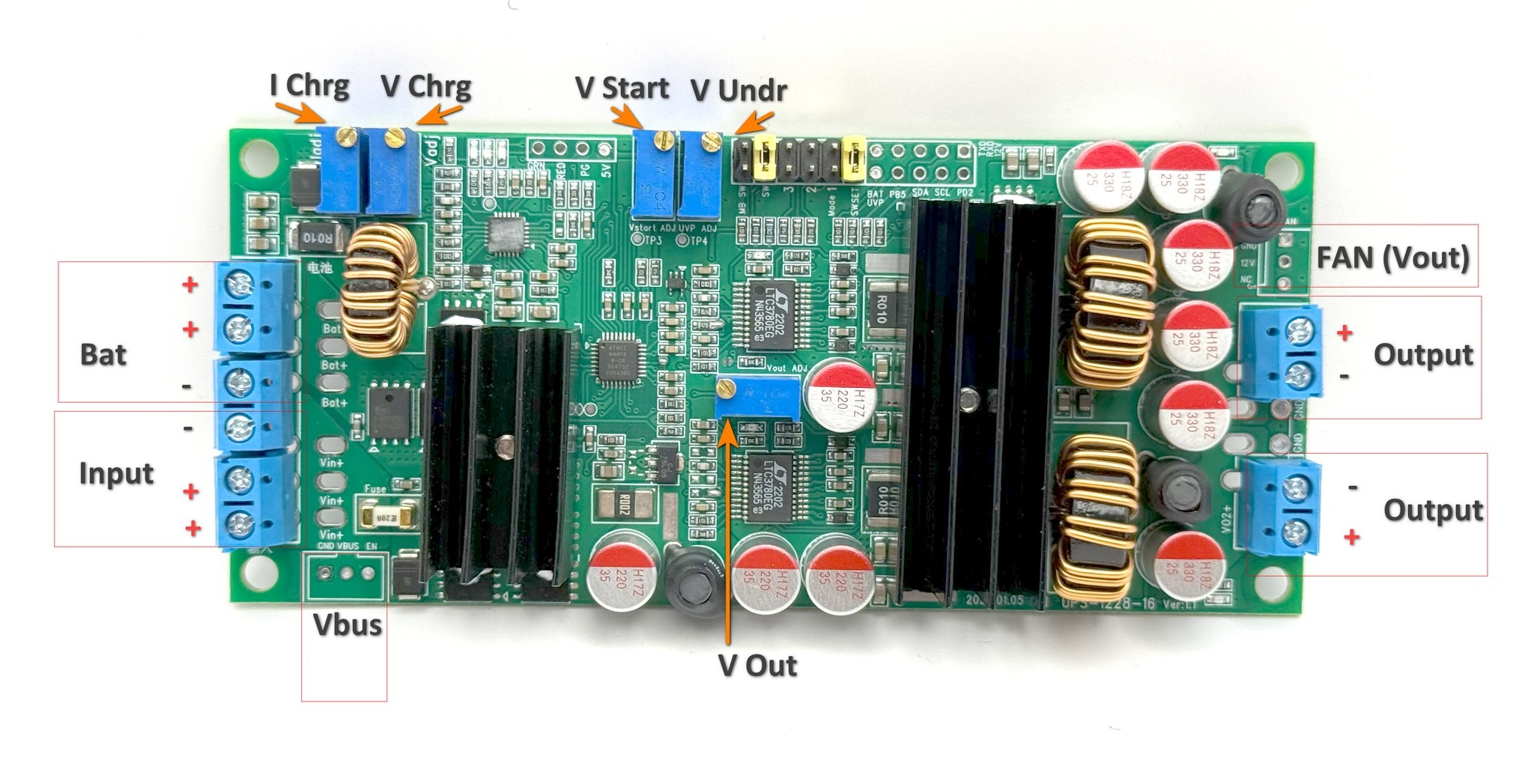
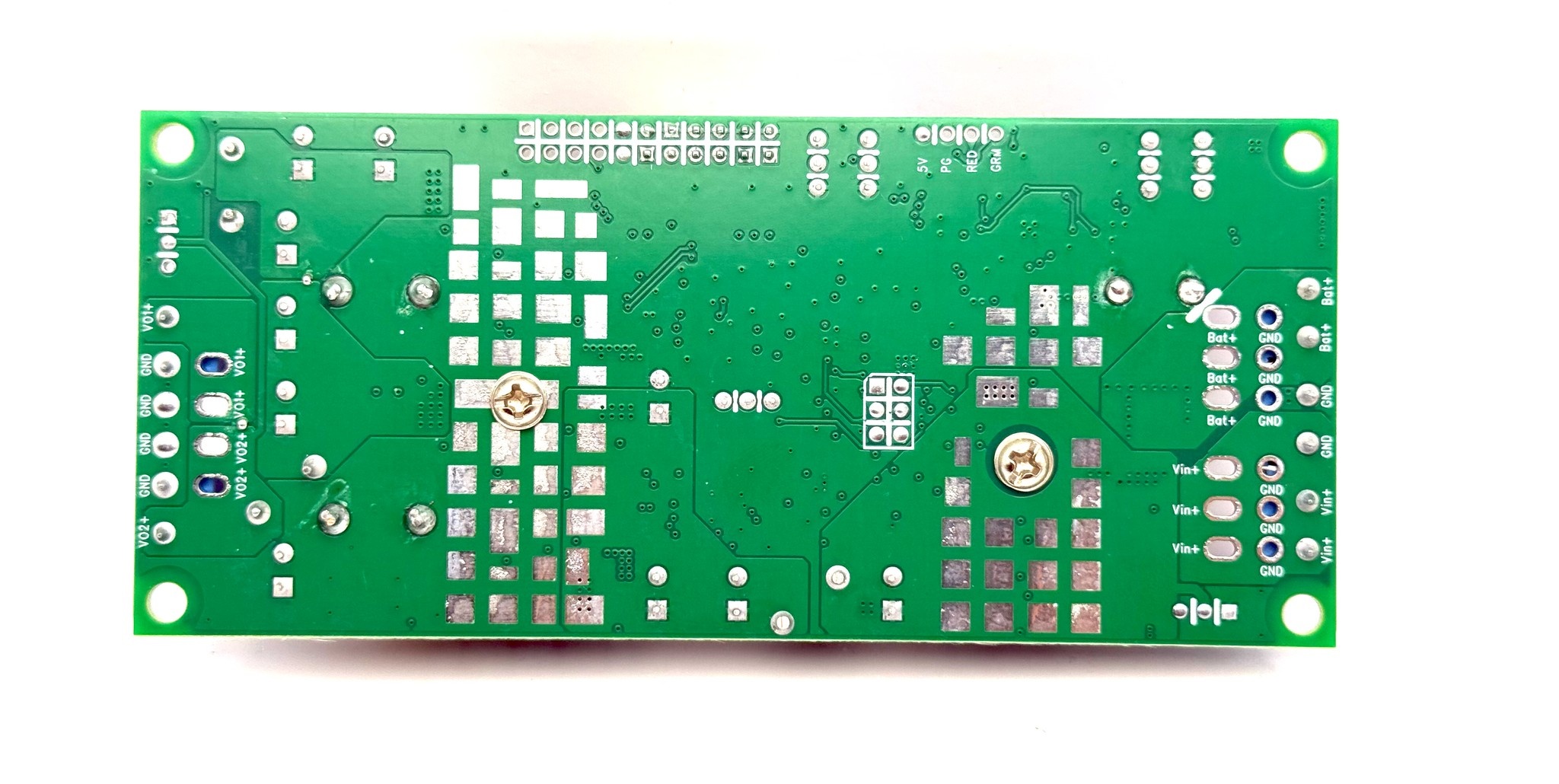
UPS-1228-16 is an efficient DC UPS power module designed specifically for applications that require a DC backup power supply. The module has a wide input voltage range and supports lead-acid batteries, lithium-ion batteries, lithium polymers, and lithium iron phosphate batteries as backup batteries. It has complete charging management functions and an onboard automatic voltage regulation circuit that can directly provide regulated DC power to the equipment. When switching between the input power supply and the battery, the output voltage remains stable and unchanged, and the load operation is unaffected.
...
Please note that the charging part of this module is step-down charging, and the input power voltage must be 1V higher than the charging cut-off voltage of the charged battery in order to charge. For example, if a 12V lead-acid battery is used and its charging cut-off voltage is 13.8V, then the input power supply should be a DC power supply between 14.8V and 28V. We can choose a common 19V or 24V power adapter as the input power supply.
The module comes with an automatic voltage regulator circuit, which can adjust the output voltage between 5V and 24V regardless of the input power or battery voltage.
Application scope:
- Provide backup power for computers with a single 12V power supply
- Access control and security backup power supply
- Backup power supply for industrial control system
Product Features:
- Wide input voltage range: 10-28V
- Dual LTC3780 parallel stabilized output, a continuous output power of 200W (output 12V, 16.7A), a peak value of 240W.
- Seamless output switching, automatically switches to a battery power supply when the input loses power, uninterrupted output voltage, and zero switching time.
- Output voltage: can be adjusted
...
- freely between 5-24V
...
- .
...
- The default shipment is adjustable with 12V output.
- Output current: 16.7A, peak value 20A
- Input current: maximum 20A
- Output overcurrent and short circuit protection, even if the output terminal is short-circuited,
...
- the circuit will automatically protect.
- Support lead-acid batteries (Pb), lithium-ion batteries (Li-Ion), lithium polymers (Li-Pol), and lithium iron phosphate (LiFePo4) batteries
- Adjustable charging voltage (4-23V)
- Adjustable charging current (1-8A)
- 3-stage high-efficiency trickle, constant current (CC), and constant voltage (CV) charging, self-stopping when fully charged to prevent overcharging
- 4 LED status indicator lights to indicate the status of input power, charging, discharging, and battery Undervoltage
- Real-time battery voltage monitoring, automatically cutting off output in case of over-discharge, protecting the battery
- Adjustable battery under voltage protection threshold voltage
- Adjustable battery start-up threshold voltage
- All solid state capacitors, output LC filter, low ripple output.
- 4-layer PCB design
Input/output pins:
...
Left side
- Bat +: Positive pole of battery
...
- Bat +: Positive pole of battery
...
- Bat -: Negative pole/ground
...
- Input -: Negative pole/ground
...
- Input +: Input positive pole
...
- Input +: Input positive pole
7: Output positive pole
8: Negative pole/ground
9: Negative pole/ground
10: Output positive pole
J1: Bus power supply external output interface, VBUS is the bus voltage output without voltage regulation, EN is the 5V enable signal output. Weldable XH2.54 socket.
...
Right side
- FAN: External output power interface, can be connected to a fan or other loads. The voltage and output voltage are the same output. Weldable XH2.54 socket.
J3: Reserved
J4: Mainboard power on/off control output. When used as a backup power source for a computer, the module can be connected to the PWR_SW power on/off control pin on the motherboard through J4 to control the motherboard's power on/off. When the battery is under voltage and not in Mode 0 state, the power board will delay sending a shutdown signal to the motherboard for shutdown.
J5: Power switch.
J5 (normally closed) startup power supply, (normally open) shutdown power supply.
J7: Standby mode selection, default to normal standby mode.
Short circuit: In normal standby mode, the standby current is about 3mA.
Open circuit: Low power standby mode, standby current of about 0.2mA. After entering low-power standby mode due to low battery voltage (J5 is normally closed at this time), the module will not automatically turn on after the input power is turned on. J5 must be disconnected and then reconnected before it can be turned on.
J6: Output voltage up and down delay setting jumper (this jumper is only applicable when the load is a computer motherboard and is not set in other situations (i.e. mode 0)
At Mode 0, there is no power on/off delay. When the power switch J4 is turned on, the output is turned on, and when it is turned off, the output is turned off. The default is Mode 0.
When the battery is powered on, when the battery voltage drops to the undervoltage protection (UVP) setting value, the power supply automatically sends a shutdown command to the motherboard and follows the delay time set in J6
J8: The external lead out terminals of LED1-LED3 should be connected to this socket when an external LED is needed. Please refer to the board silk screen for pin definitions.
The connection method is shown in the following figure:
VR1: Charging current adjustment potentiometer
VR2: Charging Voltage Regulating Potentiometer
- Output +: Output positive pole
- Output -: Negative pole/ground
- Output -: Negative pole/ground
- Output +: Output positive pole
Bottom
- Vbus: Bus power supply external output interface, VBUS is the bus voltage output without voltage regulation, EN is the 5V enable signal output. Weldable XH2.54 socket.
Upper side
- I Chrg: Charging current adjustment potentiometer
- V Chrg: Charging Voltage Regulating Potentiometer
- V Start
...
- : Battery start-up threshold voltage adjustment potentiometer
...
- V under: Battery undervoltage protection threshold voltage adjustment potentiometer
...
- (for PC settings jumpers/connection part see UPS-1228-12 datasheet)
Center
- Vout: Output voltage adjustment potentiometer
Voltage Control Points
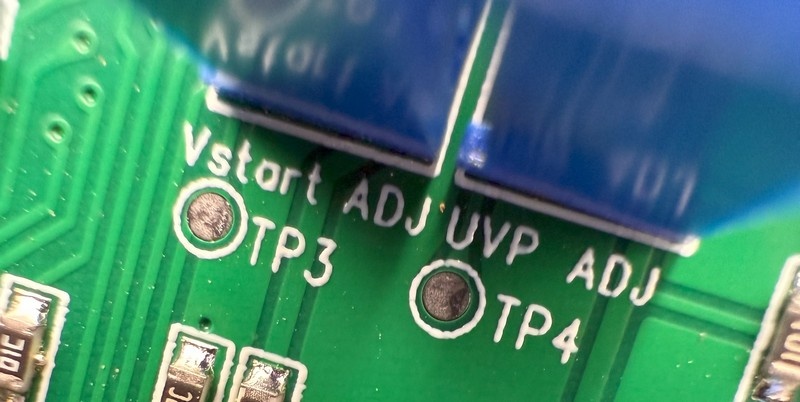
- TP3 - V Start divided by 4 (for 10.4v TP3 measurement should be 2.6v)
- TP4 - V under divided by 4 (for 9.6v TP4 measurement should be 2.4v)
- Vout, Vbat control points is outputs itself
LEDs
LED3: Input power indicator light, blue. When the input power is normal, it lights up
...
LED5/LED6: Voltage stabilizing output fault indicator (PG) light, red, turns off when the output is working normally, and lights up when the output is faulty
T1: Turn on Vout 5 seconds after the power switch SW is turned on
T2: Send a power on signal to the motherboard PWR_SW 5 seconds after Vout is turned on, and the computer will automatically power on
T3: The computer is working normally during this period
T4: The power switch SW is disconnected, and the power delay sends a shutdown signal to the motherboard PWR_SW. The computer automatically shuts down, and Vout still has output at this time. T4 stands for Off Delay.
T5: After sending the shutdown command, the Vout is delayed and disconnected, the motherboard is completely powered off, and the module enters sleep mode. T5 stands for Hard Off Delay.